Open Water Diving
Part of the Ko Samui–Ko Pha-Ngan–Ko Tao trio, Ko Tao may be the smallest in size, but makes up for that fact with arguably the best beginner scuba diving in the world.
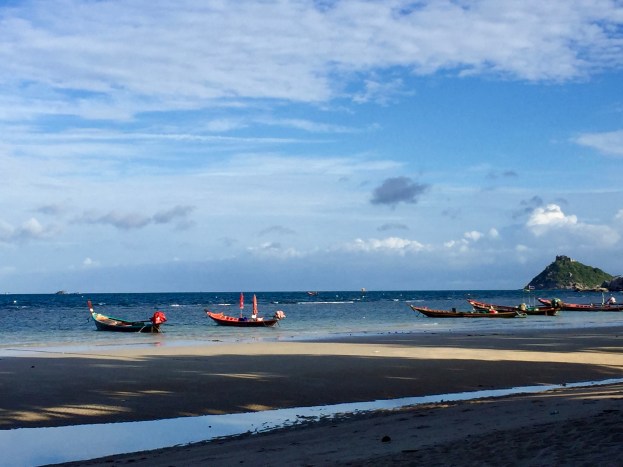
Although I grew up in South Florida, I am embarrassed to admit that I never seriously considered getting scuba certified. It wasn’t until I moved to Japan and began hearing anecdotes from my friends, describing how awesome it is under the sea, seeing all the cool fish and sea creatures, that I started researching where I could go in Asia for my open water certification.
Ko Tao proved to be THE place to be! With over 50 dive shops to choose from, there is no wrong path to take. I decided to book my Open Water course a few weeks in advance to ensure I could dive with the company of my choosing. It was important to me that I chose a trustworthy, well-trained, and knowledgeable company, so I used TripAdvisor to peruse reviews and selected Roctopus Dive as my shop!
Why Roctopus? Well, the first thing that caught my attention was all of the amazing, 5-star reviews. As I read, the reviews were written from a variety of people, some of who had dived before and many who knew nothing about scuba diving prior to the course. It made me feel at ease knowing Roctopus was successfully training individuals who were first timers, and a little nervous, like myself. The second thing I loved was the small group size guarantee. Roctopus does not allow more than four people per instructor. Again, this boosted my comfort. Something new I learned while researching was that some dive shops give you a PADI certification and others give you a SSI certification. While there are a few differences between the two, both certifications are accepted worldwide and never expire, which was most important to me. As Roctopus is with SSI, that is where my Open Water certification lies.
Now you may be wondering, what exactly is an Open Water course? An Open Water course is a 3-4 day, beginner diving course. By the end of the course, you will have successfully completed four dives, going as deep as 18 meters.
Day 1
Day one is usually reserved for an orientation, followed by covering all of the basic diving skills in either a pool or a shallow area in the ocean. You also have to do a quick swim test, where you are required to either tread water or float for ten minutes. With my Roctopus group, our instructor, Phil, chose to forgo the pool and we spent the day in the shallows. This first day was by far the most exhausting, mentally and physically, for myself. We were out in the water for around five hours (with no breaks), practicing all of the necessary skills. If I could rewind, I would have definitely eaten a bigger breakfast beforehand! Lesson learned.
Day 2
Day two was a little easier mentally, as we got to have our first two official dives. We continued to practice the skills we learned on day one while under the sea. At the start of dive one, I was struggling to control my breathing under water, admittedly to the point that I started to worry if I could actually do this scuba diving thing. But Phil was incredibly understanding. He slowed down the pace for our group and moved us back to the shallows until I felt comfortable again. Once I shook my nerves and steadied my breathing, we gradually made our way back down to the deeper depths.
Day 3
Day three was by far the best. At this point, we all felt comfortable with what we had learned. (I had also figured out my own solution to help my breathing difficulties, which you can read about below). I had so much fun on dives three and four. We got to finally put our brains to rest and enjoy the scenery! We swam by tons of fish and coral, so thrilling to see up close and personal. I had previously gotten so caught up in trying to remember what to do and what not to do under the water, that today was a perfect reminder of why I wanted to learn to scuba dive in the first place!
I did it!
I would not dare say that I was a natural at scuba diving, but I felt comfortable by the conclusion of the course. I’m not sure when nor where I will take my next dive, but I can confirm that Ko Tao was indeed the perfect place to get Open Water certified. The ocean, although a bit murky while we were out and about, didn’t have a strong current, which made practicing our skills much easier. Additionally, there aren’t many dangerous sea animals to be aware of in Ko Tao, which allowed us to focus solely on diving. Finally, Ko Tao is also an extremely cheap place to get certified. The Roctopus Open Water course was only 8,600 Baht (about 248 USD), which is nearly half the price of getting certified in Japan or Australia.
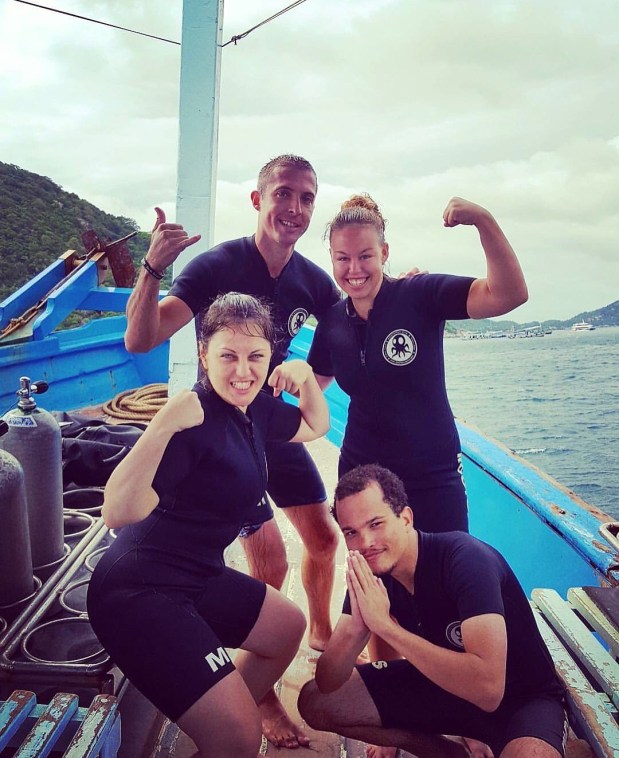
I wish I could have had tons of pictures to post, but unfortunately I did not have a go-pro and even if I did, we weren’t allowed to use them during our training. However, I had an incredible group and we decided to pay a little extra and have a video made of our third dive. I’m so glad we decided to do this, as it is something I can now look back to forever.
Feel free to enjoy the video by clicking below. Please excuse the tired faces. We were excited (honest!), but it was 6 a.m., soooo you know how it is.
*Side note about my difficulty breathing at the initial descent*
Something I figured out on my own, which may help someone in the future… I mentioned that I struggled on the initial descent into the water. Phil taught us to put our regulator, the breathing tube, into our mouth about 5-10 seconds before beginning to go under the water. However, as soon as I put the regulator in my mouth, above water, I would find it extremely hard to breath. This is because the regulator does actually make it harder to breath until you go under the water. For whatever reason, it was harder for me to breath above water than everyone else. So in the seconds before descending, I’d already feel myself breathing uncomfortably and my heart rate increasing. Then, by the time I got under the water, my breathing would be very rapid, which as a result, would freak me out. I felt like this happened every time we had to descend, whether for a dive or to practice a skill, so I found a solution for myself. What I started to do, was this: I’d wait until my head was almost under the water before I put my regulator in. I also leaned my head back as I put my regulator in and went under the water. This opened up the airways in my lungs for that second or two I was above the water with the regulator in. It sounds silly, but the effect was huge. I felt 100% more relaxed on the descent, which I felt allowed me to successfully enjoy the rest of my dive!
 When You Wander